How it works
Chaos Signals is a trend-following strategy. It records the signals produced by the Chaos Signals Pro indicator and manages every position with predefined, measurable rules.
In one minute
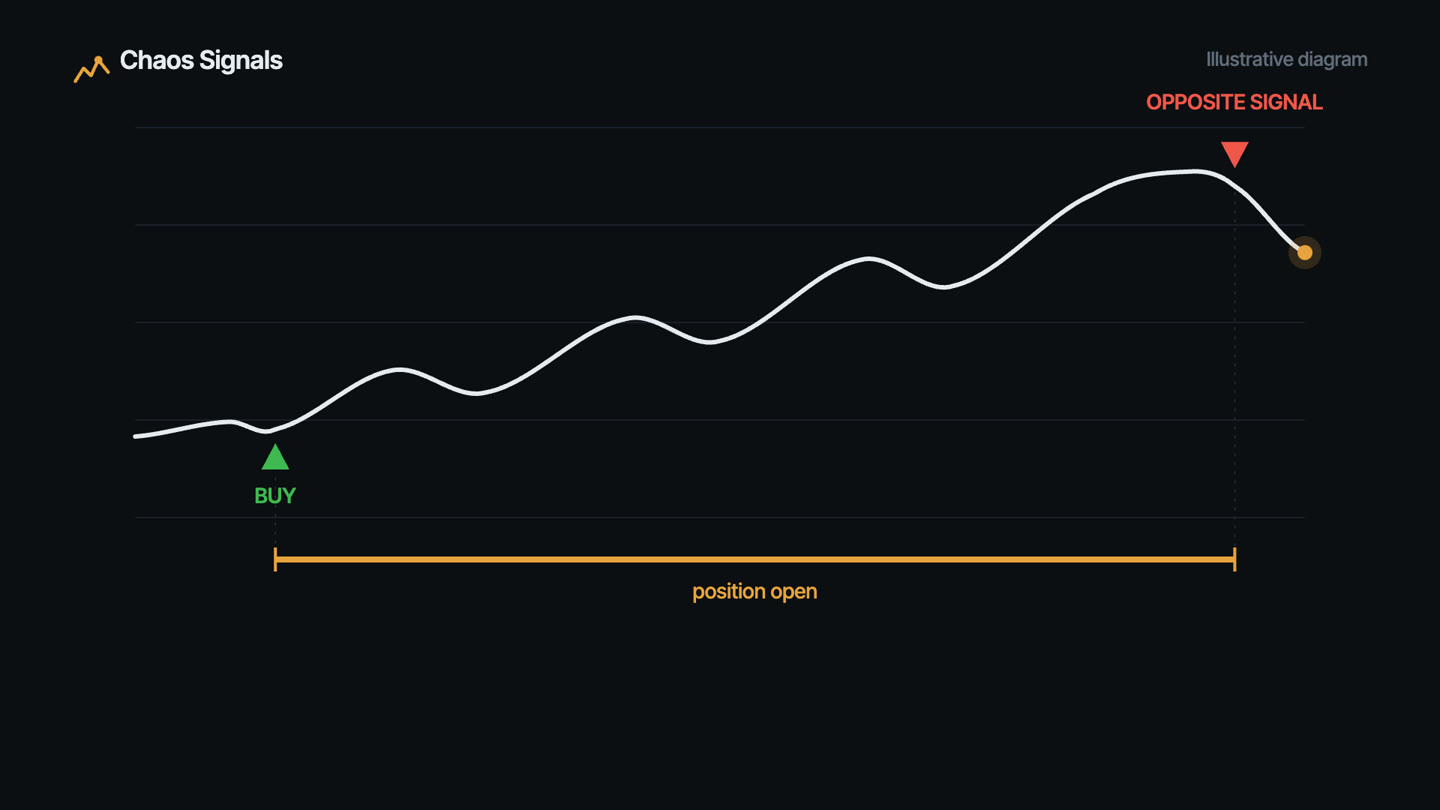
No target price
Most strategies hand you a target price. But the trend doesn't stop there.
The Chaos Signals Strategy gives no target price: a position stays open until a signal in the opposite direction arrives. When it does, the position closes at that price and a new one opens in the new direction.
One exception: the 3-bar profit stop
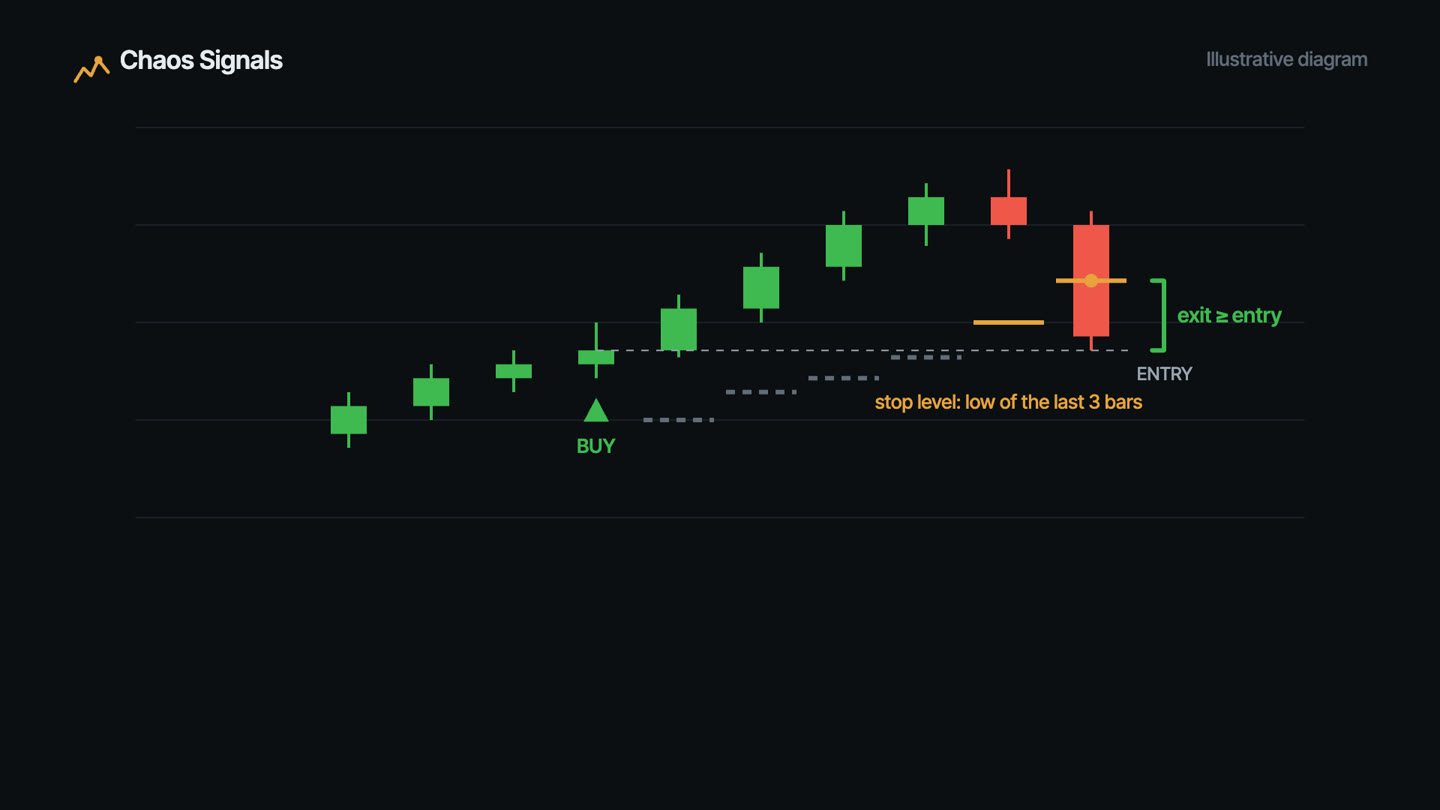
While a position is open, the low (long) or high (short) of the previous three bars is tracked as the stop level. If price breaks it, the position closes at the level itself.
The stop only arms when that level is better than the entry price. If the level is behind the entry, the stop stays inactive and the position waits for an opposite signal. That's why a triggered stop never exits worse than entry.
Signal types and order size
Order size depends on the signal type; a strengthening trend is followed with a larger order.
| Signal | Order |
|---|---|
| Opening on a bullish / bearish divergence | $5,000 |
| Opening on an AO-based signal | $10,000 |
| Each same-direction add | $15,000 |
Adds stack on top of the opening order and cost is weighted by each tranche's size. Example: $10,000 bought at 100 and $15,000 at 110 gives an average cost of 105.77 (a plain average would say 105).
The book starts with $100,000 and uses no leverage: capital tied up in positions cannot exceed the starting capital. When there isn't enough, the signal is skipped and noted on the panel. Commission is $1.50 per order; opening and closing are separate orders.
When signals arrive
Signals are sent the moment the condition forms, before the bar closes. This is deliberate: trading during the day requires not waiting for the bar to close.
The cost is on the record too: the entry price may be recorded a few ticks past the triggering level. If the condition breaks before the bar closes, the signal may disappear from the chart but stays on record.
What you see on the panel
- Open positions
- Each position is marked to the daily close. Delayed or stale prices are flagged; if there is no price at all, no made-up value is shown.
- Closed positions
- Every trade closed by an opposite signal or the 3-bar profit stop is listed with its result after costs.
- Event feed
- Every incoming signal appears in time order. “Reversed” only appears when a position actually closed; if there was nothing to close, it is labeled “new signal”.
- Premium
- Premium members see entry prices, valuations, profit and loss, and the equity curve.
Assumptions
Assumptions: $100,000 starting capital, no leverage. Order size depends on the signal type: $5,000 to open on a divergence, $10,000 to open on an AO signal, $15,000 for every same-direction add — an add stacks on top of the opening order and cost is a weighted average. Capacity is limited by capital: invested capital cannot exceed $100,000; when there isn't enough, the signal is skipped and noted below. Commission is $1.50 per order — opening and closing are separate, and each tranche of a scaled entry is its own order. Signals cover stocks, ETFs, futures, forex, commodities and crypto; everything is USD-denominated. Futures are treated as cash positions — real contract sizes and leverage are not modeled. Volatility differences between instruments are not normalized. Results are hypothetical and are not an indication of future returns.